Fire, Story & Spice The Living Archives Series V The Diaspora Pot: How West African Food Changed Abroad Without Losing Itself
Fire, Story & Spice
The Living Archives
Series V
The Diaspora Pot: How West African Food Changed Abroad Without Losing Itself
By Sylvester Osei-Fordwuo

Introduction
This is Fire, Story & Spice.
Fire teaches, story remembers, spice carries identity.
In Series IV, we explored how dishes like jollof rice became part of a larger conversation about identity, ownership, and shared cultural memory across West Africa.
But food does not remain in one place.
Migration changes people, communities, and eventually the food itself.
As West Africans moved across Europe, North America, and other parts of the world, cooking traditions adapted to new ingredients, environments, and generations.
This essay explores how West African food has changed across the diaspora, how families adapt recipes to new environments, and why food often becomes one of the last places where memory still feels like home.
Unanswered Questions
“How do West African immigrants preserve their food traditions? Is this authentic West African food? Where do you get your spices?”
These are some of the questions we hear regularly at our restaurant, African Grill and Bar. Food is often one of the first things Africans try to preserve after migration. Long after accents change, routines shift, and people adjust to a new country, they still search for familiar tastes and cooking traditions that remind them of home.
When I first moved from Ghana to Colorado, I spent nearly a month searching for Scotch bonnet peppers to make pepper stew. Across the diaspora, similar experiences happen every day. A Nigerian father in Toronto may teach his children how jollof rice should taste. A student living abroad may try to recreate waakye or light soup using whatever ingredients are available nearby.
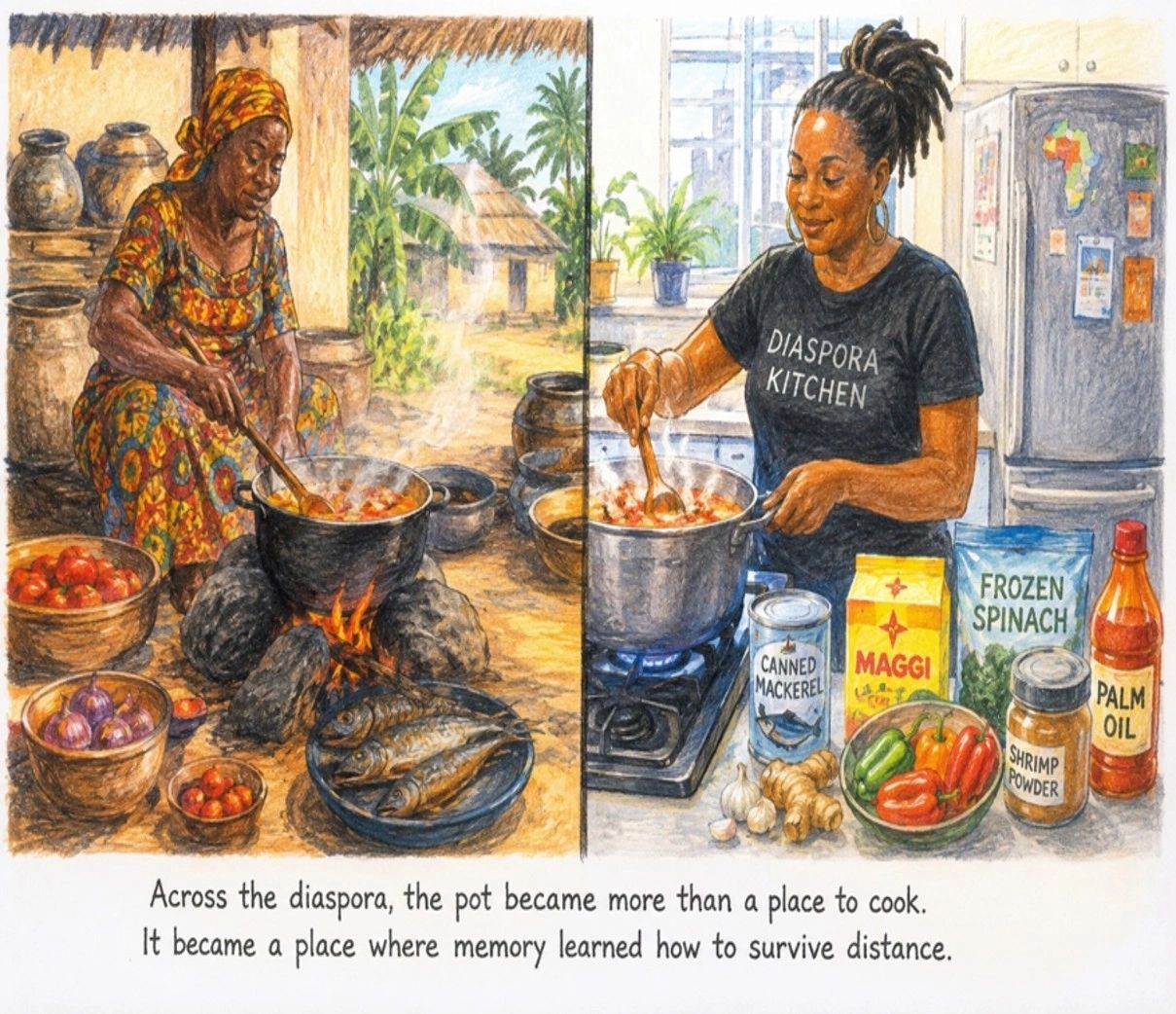
Diaspora cooking begins somewhere between memory and adjustment. It is not always about perfection or recreating a dish exactly as it was prepared back home. It is about maintaining an ancestral connection while learning how to cook in a completely different environment.
Over time, the diaspora pot becomes more than a kitchen tool. It becomes a place where culture survives, adapts, and continues across generations.
Pull Quote
“A dish that travels does not remain frozen in time. It survives by learning to live somewhere new.”
The Pot Changes Because the Environment Changes
One of the biggest misunderstandings about African food in the diaspora is the assumption that traditional dishes can remain unchanged after migration. In reality, food is shaped by the environment. Ingredients change from one country to another, and those differences affect flavor, texture, and cooking methods.
In Ghana, ginger roots are known for their strength and potency. Our mothers and grandmothers often used ginger as medicine, especially for colds and flu. They would mash the roots to make a strong drink or ask you to chew and swallow the juice. In some homes, traditional remedies even involved using mashed ginger treatments in ways many people outside Africa may find unfamiliar today. But growing up, those practices were part of how families cared for the sick before modern medicine became widely accessible.
Whenever I use ginger here in Colorado, whether for tea or cooking, I immediately notice the difference. The flavor is milder and less intense than what I grew up with in Ghana. The same is true for many other ingredients. Even the potency of star anise changes from place to place. Theodora often remembers her father driving her to Cape Coast to buy fresh fish because the taste was completely different from the fish available in Colorado today.
Even water affects cooking. Anyone who has prepared rice in different countries understands this immediately. The same recipe can produce different results depending on the ingredients, climate, water, and the environment surrounding the food.
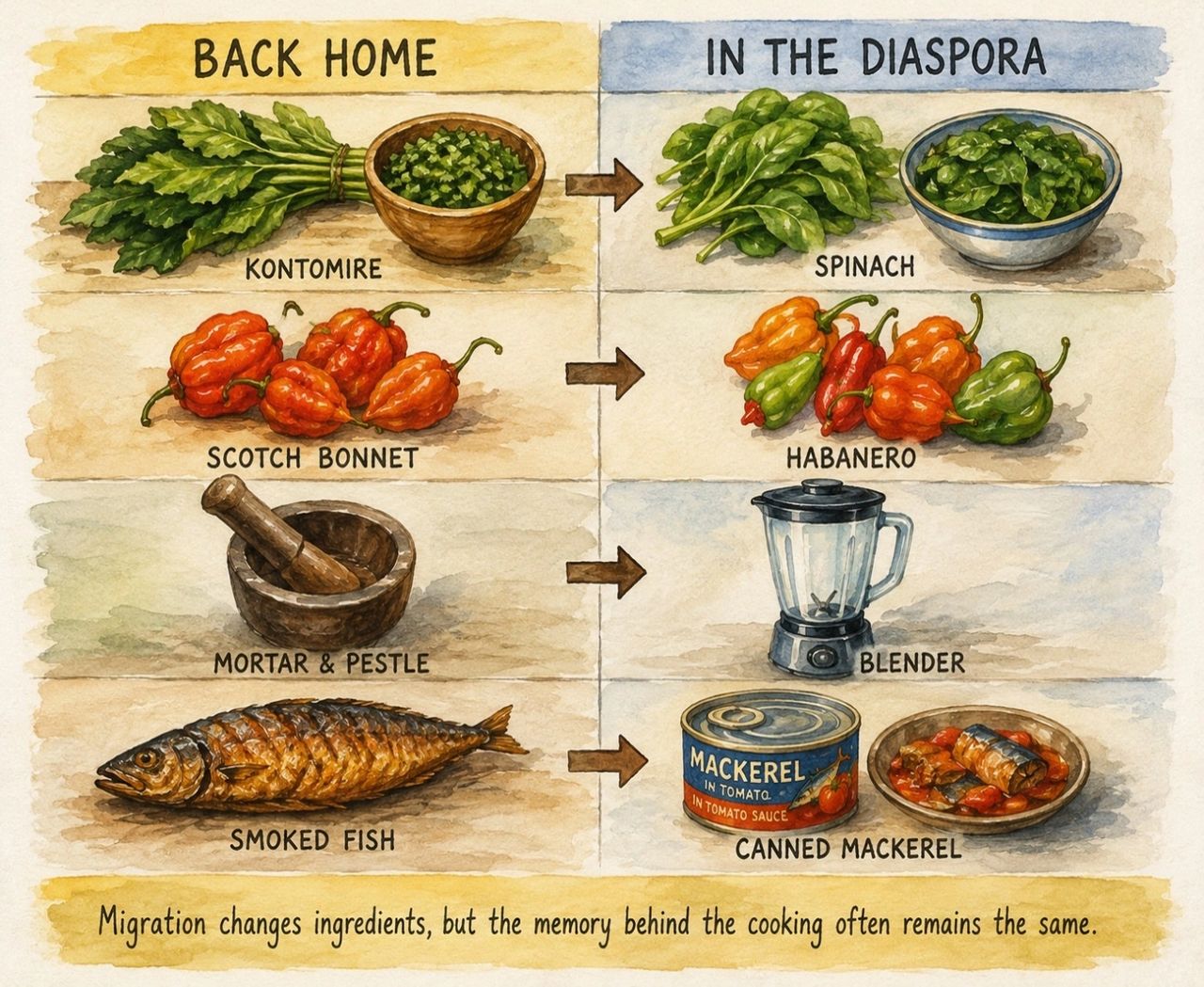
Because of these differences, diaspora cooks constantly adjust. If kontomire leaves are unavailable, spinach or Swiss chard may be used instead. When familiar seasoning cubes are difficult to find, cooks substitute local bouillon powders. In some homes, puff-puff is baked rather than deep-fried because of cost, kitchen limitations, or health concerns. Smoked fish flakes or shrimp powder may replace fresh seafood while still preserving familiar flavor.
Some substitutions come from creativity. Others come from necessity.
I remember my first week in Denver after moving from Ghana. I wanted to prepare groundnut soup the way I made it back home. I searched everywhere for smooth peanut butter but could not find any. The only peanut butter available was the sweetened kind made for sandwiches. I tried using it anyway. The soup was terrible.
That experience taught me something important about diaspora cooking. Sometimes the cook must fail first before learning how to rebuild familiar flavor in a completely different environment.
Technology has also changed the kitchen itself. Blenders and food processors now replace the traditional apotoyewa, or mortar and pestle, in many diaspora homes, especially for families balancing work, school, and long hours.
These adjustments are not signs that tradition has failed. They are signs that the culture is still alive.
West African cooks have always adapted to changing environments, ingredients, and circumstances. Diaspora cooking simply continues that tradition in another part of the world.
Pull Quote
“Diaspora cooking is not imitation. It is a negotiation.”
The Myth of “Pure” Authenticity
Diaspora communities are often pressured to prove authenticity. Questions constantly appear around food:
- Is this the “real” jollof rice?
- Is this how it is cooked back home?
- Would our grandmothers approve?
- This does not taste like my grandmother’s egusi.
These questions overlook an important reality: West African food has never been static. Like all cuisines, it has evolved continuously through migration, trade, religion, agriculture, economics, climate, and colonization.
Many ingredients central to modern West African cooking did not originally come from Africa. Tomatoes, peppers, and several rice varieties arrived through centuries of global movement before becoming fully integrated into local cuisines.
Many dishes people now call traditional were also shaped by change over time. That matters because it reminds us that change has always been part of African food history.
A friend of mine named Kwaku once described making light soup after moving from Accra to Montreal. The tomatoes tasted sharper than the ones he remembered from Ghana, and he used jalapeños because Scotch bonnets were difficult to find. He admitted the soup tasted different from his mother’s version, but when the aroma filled his apartment, it still gave him the same comfort he associated with home.
That experience captures something important about diaspora cooking: emotional recognition often matters more than exact replication.
Pull Quote
“Every traditional dish was once somebody’s adaptation.”
The Emotional Weight of Diaspora Cooking
Diaspora cooking is not only practical. It is deeply emotional.
For many immigrants, cooking becomes one of the few places where memory still feels complete. Certain smells and sounds can immediately transport someone back home. The aroma of kontomire stew may remind a person of their mother’s kitchen. The sound of onions frying in oil may bring back memories of family gatherings, funerals, holidays, or evenings spent eating together after a long day.
In many diaspora homes, food becomes more than nourishment. It becomes emotional continuity.
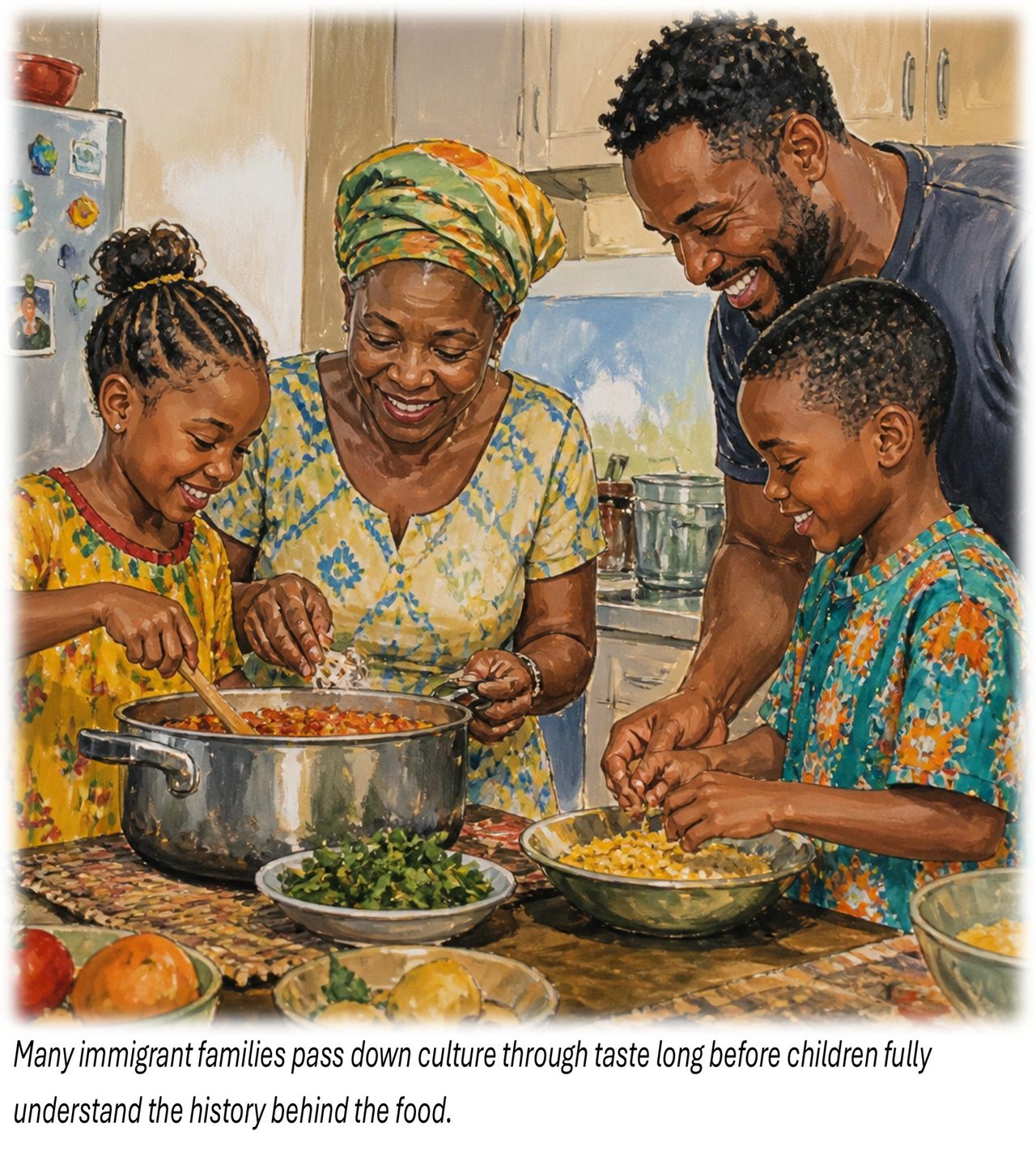
This is especially true for parents raising children outside Africa. Many are not simply feeding their children. They are trying to pass down identity, memory, values, and belonging through everyday meals.
Over time, language may change. Accents may shift. Names are sometimes shortened to fit new environments. But food often remains one of the strongest cultural connections within immigrant households.
That is why cooking in the diaspora carries so much emotional weight. People are not only preparing meals. They are trying to preserve connection across distance, time, and generations.
Pull Quote
“For many immigrants, the kitchen becomes the last place where home still feels fully intact.”
First Generation Preservation vs. Second Generation Reinvention
There is often tension between generations in diaspora kitchens.
First-generation immigrants usually cook from memory. They want food to taste as close as possible to the versions they grew up eating back home. The smell, texture, and flavor matter deeply because those meals remind them of family, childhood, and home. Many of them try to preserve traditional cooking methods because the food holds emotional and cultural significance.
Second-generation cooks often see food differently. Many of them grow up between cultures, so mixing flavors and experimenting with ingredients feels normal. Their cooking reflects both where their families came from and where they were raised.
Because of this, disagreements sometimes happen in the kitchen. Parents may feel that certain changes move too far away from tradition, while younger cooks may see those same changes as creativity and self-expression.
Both sides are responding to their own experiences.
One generation is trying to preserve memory.
The other is trying to express identity.
In many families, cooking together becomes the bridge between those different perspectives.
I see this often in my own home.
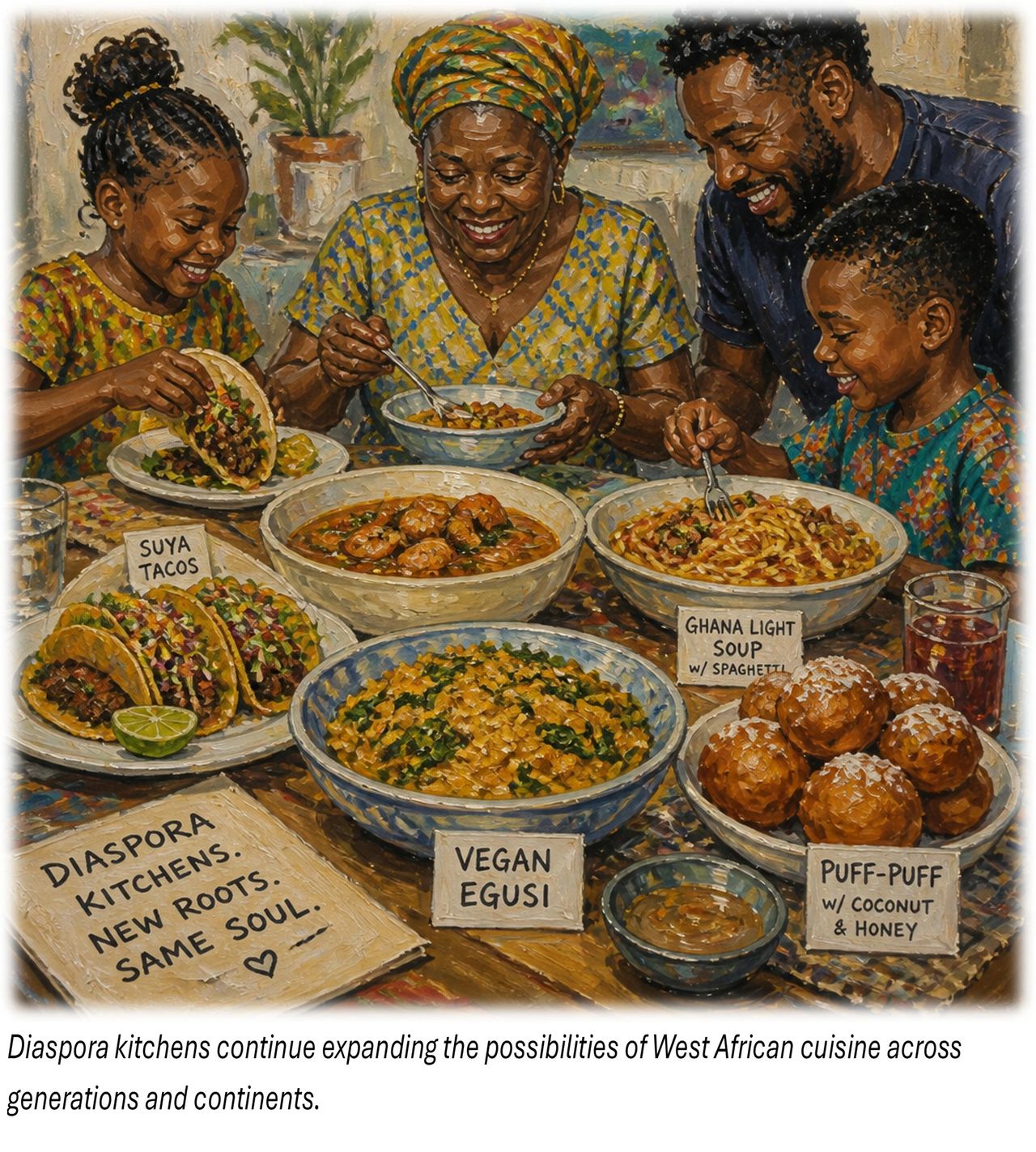
My first daughter, Nana Serwa, likes eating meat pie with shito and insists the combination tastes perfect. My second daughter, Maame Antwiwaa, enjoys light soup with spaghetti, something that still surprises me whenever I see it. My wife, Chef Theodora, completely disagrees with that pairing because she believes light soup should be eaten with fufu, not noodles.
These conversations usually begin with disagreement, but they often end with laughter, storytelling, and shared meals. Everyone explains why they like certain flavors or combinations, and somehow the kitchen becomes a place where different generations learn from one another.
I once heard a similar story from a Ghanaian mother living in Toronto. She told me her son started adding maple syrup to his waakye. At first, she wanted to correct him because it did not fit the version she grew up eating. Later, she realized the combination reflected both his Ghanaian background and his Canadian environment. Eventually, they began preparing their own version together for family meals.
Experiences like these show that diaspora cooking is not only about preserving recipes. It is also about preserving relationships, memories, and cultural connection.
Food becomes a meeting point between generations. It allows families to hold onto tradition while also making room for change.
Pull Quote
“The first generation cooks to remember home. The next generation cooks to explain who they became.”
Why Diaspora Food Expands the Culture.
Some people view diaspora food as weaker or less authentic than food prepared “back home.” But conversations about authenticity have always existed, even within African communities themselves.
I remember speaking with my auntie in London about the way she prepares egusi soup. She still insists on grinding her melon seeds by hand because that is how she learned to cook in Nigeria. Her daughter, on the other hand, sometimes adds spinach when traditional vegetables are difficult to find. The two of them joke constantly about who is cooking the “real” version of the soup. Yet despite their differences, they both admit that preparing the meal together keeps them connected to home and to each other.
That is what many people misunderstand about diaspora food. The conversation is usually not about whether culture is being abandoned. It is about how culture survives in a different environment.
Some cooks work hard to preserve traditional methods exactly as they remember them. Others adapt recipes to fit new ingredients, new schedules, and new countries. One person may insist that jollof rice cooked over charcoal tastes completely different from jollof made on a modern stove. Another person may proudly combine local ingredients from their new city with recipes they inherited from their parents.
Both approaches are part of the same story.
Food carries memory, but it also responds to life around it.
If you have ever adjusted a recipe because you could not find a certain ingredient, added your own twist to a family dish, or combined two cultures on one plate, then you already understand this process. Those changes do not automatically erase tradition. In many cases, they become part of how the culture continues growing.
That growth is one reason West African food has gained visibility worldwide.
Dishes such as jollof rice, suya, waakye, puff-puff, egusi, kelewele, and fufu became widely recognized because immigrants carried them into new spaces through restaurants, churches, festivals, universities, weddings, and family gatherings.
I have seen this personally through African Grill and Bar here in Colorado. Many customers walk into the restaurant trying West African food for the first time. Some arrive curious about jollof rice after hearing about it online. Others discover suya, kelewele, or waakye through friends and community events. Over time, many of them return, not only because of the food itself, but because they become interested in the stories and culture connected to it.
The same thing happens in diaspora communities across the world. Festivals, potlucks, naming ceremonies, and community gatherings often become places where people introduce others to the foods they grew up eating. A plate of food opens conversation. It creates familiarity between people who may come from completely different backgrounds.
At the same time, diaspora cooks also face challenges. African food is sometimes misunderstood, stereotyped, or treated as unfamiliar in public spaces. Certain dishes only become widely accepted after they are repackaged by mainstream food culture, often without proper recognition of the communities that created them.
I have watched foods like jollof rice become trendy in spaces that rarely acknowledge the long history behind the dish or the people who carried it across generations and borders. I have also seen fufu turned into online entertainment by people more interested in reactions than understanding the culture itself.
Still, diaspora communities continue pushing the cuisine forward.
Today it is common to find vegan egusi, suya tacos, jollof arancini, and many other creative variations inspired by West African cooking. Not every experiment succeeds, and not every adaptation respects the culture equally. Older generations sometimes worry that too much change can weaken tradition, while younger generations often see experimentation as part of making the food their own.
I remember one of my uncles telling me that there are certain flavors from home he never wants to lose, even if shortcuts would make cooking easier abroad. Meanwhile, his daughter laughs that her jollof rice always changes depending on what ingredients she finds at the local grocery store that week.
Both perspectives are understandable.
The truth is that living cultures do not remain frozen. They grow, adjust, and respond to new realities. That does not make them less meaningful. If anything, it shows their strength.
Diaspora food broadens culture by allowing traditions to travel, adapt, and remain part of people’s everyday lives, even far from home.
Pull Quote
“Culture survives movement by expanding, not by standing still.”
The Diaspora Pot as a Living Archive
The diaspora pot teaches an important lesson about culture. Preserving tradition does not always mean reproducing something exactly the same way forever. Sometimes preservation means carrying the heart of a tradition into a completely different environment and finding a way to keep it alive there.
That is what many immigrant families have done for generations.
Even when ingredients changed.
Even when countries changed.
Even when daily life changed.
Families still found ways to hold onto the food memories that reminded them of home.
In many diaspora households, recipes naturally begin to adjust over time. Certain vegetables become difficult to find. The spices taste different. Cooking schedules change because life abroad moves differently. Some people use substitutes because they have no choice, while others slowly adapt recipes to fit the reality of their new environment.
At first, those changes can feel uncomfortable.
Many immigrants quietly struggle with the feeling that a recipe becomes less authentic as it changes. People sometimes feel guilty when they cannot cook a dish exactly as their parents or grandparents did back home. But over time, many realize that adaptation is not necessarily a loss of tradition. In many cases, adaptation is what allows the tradition to survive.
I have seen this happen in many families, including my own.
Over the years, I have watched people improvise with ingredients, adjust cooking methods, and recreate familiar flavors using whatever was available nearby. Yet somehow, when the food reached the table, the memories connected to it still remained. The smell still reminded people of home. The conversation around the meal still felt familiar. The food still carried identity.
That is why I often say the pot becomes more than a cooking tool.
The pot becomes an archive.
Not an archive stored in books or museums, but one carried through memory, repetition, taste, and daily practice. Every family recipe carries pieces of history inside it. Every adjustment tells a story about migration, survival, and adaptation. A substitution made in a small apartment kitchen in Toronto or Denver becomes part of the family’s evolving history just as much as the original version cooked back home.
In many ways, the kitchen becomes one of the last places where culture continues to move naturally from one generation to another.
Today, technology has expanded that archive even further.
Social media platforms such as Instagram, TikTok, YouTube, and Facebook have created spaces where diaspora communities share recipes, cooking techniques, substitutions, and family stories across continents in real time. Someone in Ghana can watch a Ghanaian-American family prepare waakye in New York. A Nigerian student in London can learn a soup recipe from an auntie cooking in Lagos. Young people raised abroad now use digital spaces to reconnect with traditions many feared would slowly disappear.
I recently heard a second-generation Ghanaian-American named Nana describe her experience posting videos of her grandmother’s groundnut soup online. She admitted she was nervous that people would criticize her shortcuts and ingredient substitutions. Instead, many young Africans responded that they made the same adjustments in their own kitchens because they faced the same challenges abroad.
That response reminded her that many diaspora families are trying to solve the same problem: how to preserve cultural connections while living far from home.
Social media has made that process more visible.
Of course, online spaces also come with disagreements. Questions about authenticity appear constantly. People debate whether certain substitutions should be accepted, whether fusion dishes go too far, or whether some recipes are losing their original meaning. Those conversations can become emotional because food is deeply tied to identity and memory.
Still, those debates also reveal something important: people care deeply about preserving their culture.
And even when people disagree about recipes, the conversation itself keeps the tradition active.
What matters most is that the knowledge continues moving.
Recipes are being shared.
Stories are being remembered.
Techniques are being passed down.
Families are still gathering around food.
The diaspora pot continues carrying memory across borders, generations, and changing environments.
Pull Quote
“The diaspora pot does not keep culture untouched. It keeps culture alive.”
Closing Reflection
Migration changes people, and it also changes food. But change does not always mean loss. In many cases, change is what allows traditions to survive.
I remember the first time we tried to make jollof rice after moving abroad. We could not find the same peppers or the same type of rice we used back home. We adjusted with what was available. The taste was different, but somehow it still felt familiar. It still carried the memory of home.
That experience taught me something important. Food does not survive because everything stays exactly the same. It survives because people continue to cook, adapt, and pass the knowledge on.
West African food across the diaspora tells a larger story about resilience, memory, and identity. Families have learned how to recreate familiar meals under completely different conditions. Some substitute ingredients. Others adjust techniques. Some combine old traditions with the realities of a new country. Yet through all these changes, the connection to home remains.
That is what the diaspora pot represents.
It represents the ability of culture to move, adjust, and survive without losing its foundation. The ingredients may change. The kitchen may change. Even the country may change. But the memory behind the cooking continues.
Many parents in the diaspora understand this deeply. They are not only feeding their children. They are teaching them where they come from. A bowl of soup, a pot of rice, or the smell of stew on the stove often becomes a child’s first connection to a culture they may not fully understand yet.
If you have ever adjusted a family recipe to fit a new environment, searched for ingredients that reminded you of home, or taught someone how your family cooks, then you are already part of this living archive.
Every diaspora kitchen carries history. Every adaptation carries memory. Over time, each meal prepared across borders becomes part of the culture's ongoing story.
Final Pull Quote
“A culture that survives migration is not disappearing. It is proving its strength.”
The Living Archive — Series Progression
- Series I — Knowledge moves
- Series II — Knowledge lives in systems
- Series III — Knowledge becomes real through practice
- Series IV — Knowledge survives through story
- Series V — Knowledge transforms through migration and adaptation
The archive continues.


Please read and drop your comments
ReplyDeleteGreat storytelling
ReplyDeletethanks for reading
DeleteI love this essay, it is on point
ReplyDeleteThanks for reading, forward it to your friends
Delete