A celebration of African flavors, heritage, and culinary storytelling — honoring the recipes, traditions, and cultural wisdom that shape kitchens across Africa and the diaspora. This blog invites food lovers to explore the deeper meanings behind beloved dishes, reconnect with ancestral memory, and experience the creativity, warmth, and community at the heart of African cuisine.
Fire, Story & Spice The Living Archives Series IV
Get link
Facebook
X
Pinterest
Email
Other Apps
Fire, Story & Spice
The Living Archives
Series IV
The Jollof Debate: Why No One Owns the Pot
By Sylvester Osei-Fordwuo
May 4, 2026|2026, The Living Archives Series
The Jollof Debate: Why No One Owns the Pot
By Sylvester Osei-Fordwuo
More Than a Meal: The Cultural Fire Behind West Africa’s Favorite Feud
Few dishes stir as much emotion as a pot of Jollof rice. Across West Africa—from Lagos to Accra to Dakar—and throughout diaspora kitchens in places like Denver, Atlanta, and London, the same question always comes up: who makes it best? At first, it sounds like a simple question. But it rarely leads to a simple answer. That’s because Jollof is not just food. It carries history, identity, and pride. Every version reflects where it comes from—the ingredients available, the cooking methods passed down, and the memories tied to it. Over time, the dish has spread across various regions of Africa and across generations through trade, migration, and everyday cooking, changing along the way without losing its meaning. So the point of the debate is not really to decide a winner. It is to recognize that what we are looking at is a shared tradition, passed on from many hands over time and generations.
A Question That Refuses to End
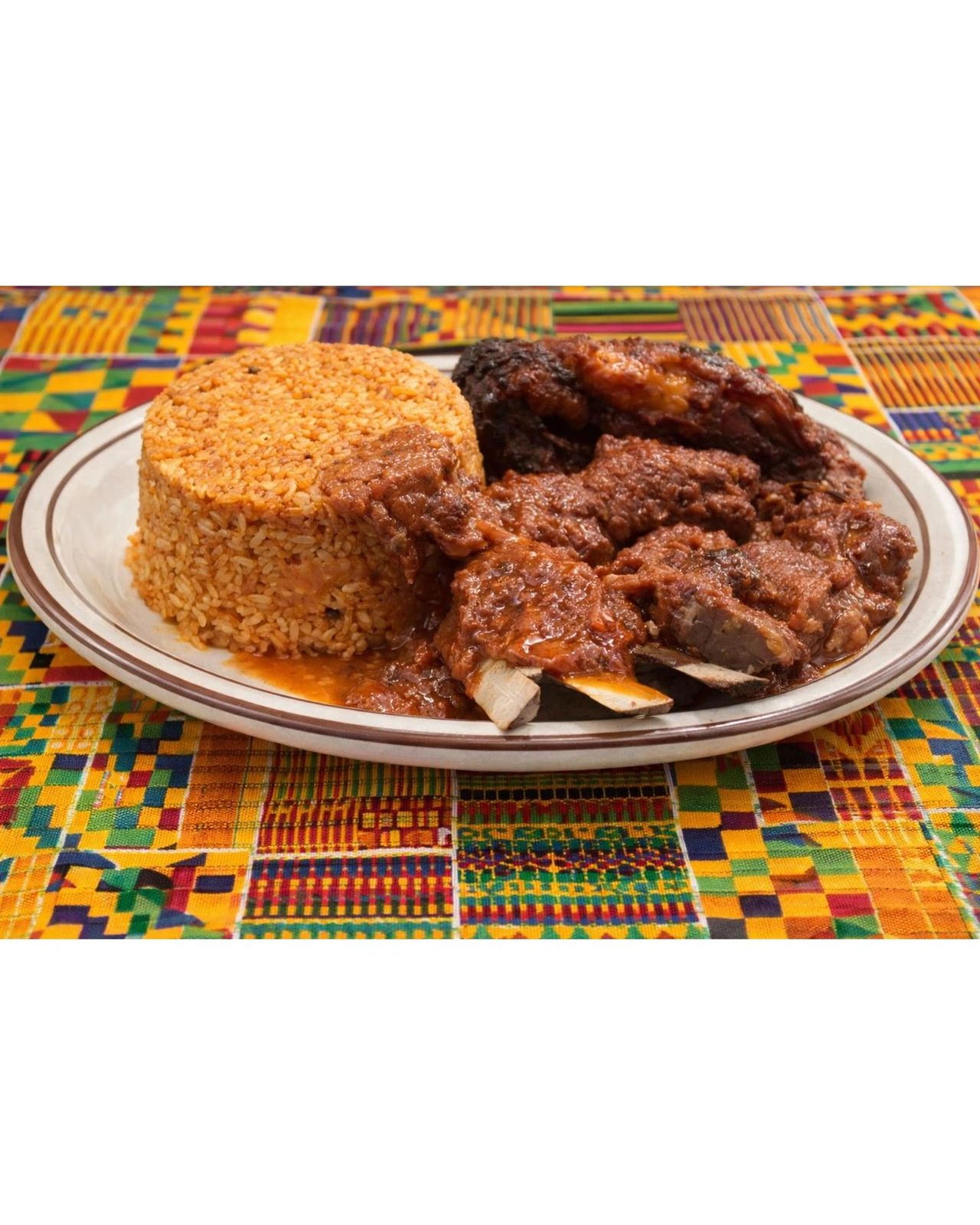
“Who makes the best Jollof?” Is this Nigerian Jollof or Ghanaian Jollof? This is the question that refuses to end at our restaurant. You can ask this question almost anywhere, and someone will answer with confidence—often followed by a strong defense. It is a conversation I hear often, and one I have learned not to dismiss too quickly. What makes the question interesting is not the answer itself, but what it reveals. People don’t just respond with preference; they respond with memory, with pride in where they come from. Over time, it becomes clear that the debate is not really about taste alone. It is a cultural practice. It allows people to express where they come from and what they value. In that sense, asking who owns Jollof misses the point entirely. Jollof Rice is a universal dish and never meant to belong to one region in West Africa. It has always been something shared, adapted, and discussed.
Pull Quote
“The argument is not a disruption of tradition. It is the tradition.”
Reframing the Debate — From Ownership to Participation
The Jollof debate is often presented as a rivalry—Ghana versus Nigeria, Senegal versus others. But that framing only scratches the surface of what is happening. At a deeper level, the debate is about participation. Growing up, I remember standing beside my mother, Maame Abena Antwiwaa, as she cooked Jollof over a three-stone fire. She would let me stir, but always reminded me to watch the fire and not rush the process. For her, heat cooks the food and not the fire. She would often say,” Patience is just as important as the ingredients themselves”. What stood out to me even then, with my mother, was that Jollof never came out exactly the same. Sometimes it was the ingredients that changed, sometimes the fire, and sometimes simply the mood of the day, because my mom had a story to go with cooking. That experience made it clear that Jollof is not meant to be fixed or identical each time. To cook is not to copy a single version, but to take part in something that is already in motion.
Five West African Regional Debates on Jollof Rice
Jollof is best understood not as a single recipe but as a regional expression. In Senegal, its roots are thieboudienne, simply fish and a deeper, layered flavor. In Ghana, it is known for its aroma from tomato stew, its balance, and the texture of jasmine rice or long-grain rice. In Nigeria, it tends to be bold and spicy, often carrying a smoky character from cooking over firewood. In Sierra Leone, jollof rice is a vibrant one‑pot rice dish that keeps the classic West African jollof foundation, rice cooked in a tomato‑pepper‑onion sauce with spices and stock, but distinguishes itself through coastal proteins and abundant vegetables.* Liberian jollof rice is a tomato‑based one‑pot rice dish, like all other West African Regions, enriched with fresh seafood and other ingredients because of its coastal proximity, ethnic diversity, and agricultural traditions.
Pull Quote
“Jollof is not owned. It is contributed to.”
The Kitchen as a Living Archive
In many West African cooking traditions, knowledge is not primarily written down—it is observed, practiced, and repeated. At a younger age, you learn how long to cook food by observing and practicing, not by checking a timer. You pay attention to the fire to control the heat by removing some of the firewood and/or reducing the charcoal, not by adjusting a dial. You learn how to balance flavor through experience, not just measurement. This kind of knowledge moves through people. It is passed from one generation to the next through presence and practice. For that reason, authenticity is not about perfect replication. It is about keeping and protecting what has been passed on to us and about how we learn and understand cooking.
Pull Quote
“Our ancestral stories organize our memory.”
The proof is in the Pot.
Jollof carries meaning from generation to generation. When someone defends their version, they are not only talking about flavor—they are expressing where they come from. When they cook it, they are sustaining our ancestral connection to that origin. This is why the Jollof rice debate keeps going on, and still holds identity within it.
Pull Quote
“Jollof War is about flavor, and a stand for a family story.”
The Pot as Shared Space
Jollof has traveled across too many places to belong to a single country or a debate between two countries. It reflects movement, throughout regions of Africa, across time, and across communities. Each version has become what people had access to, where they were, and what they carried. In that way, the pot becomes more than a recipe. It is a shared space where multiple histories exist together.
Pull Quote
“The pot does not preserve one story. It holds many.”
Jollof in the Diaspora
In the diaspora, Jollof keeps evolving as people adjust the base to what is available, substituting ingredients and changing techniques. At the same time, the intention behind the cooking remains the same: to stay connected. In many cases, that connection becomes even more important when people are far from home.
Pull Quote
“Distance does not weaken the story. It amplifies it.”
Jollof in the Modern Age
Today, the Jollof debate has expanded into virtual domains—videos, social media discussions, and public comparisons. While this has brought more visibility, it can also reduce the depth of the conversation. Complex traditions are sometimes simplified into quick judgments or rankings. The issue is not the debate itself, but the loss of context that gives it meaning.
Pull Quote
“When context is lost, culture becomes content.”
Participation vs Ownership
At its core, the debate raises a bigger question about how culture works. Ownership suggests control, and participation suggests contribution. Yet, Jollof continues to exist and grow because people keep adding to it. However, not every additional voice is visible, and some traditions are less represented than others. Making space for additional voices strengthens the tradition as a whole.
Pull Quote
“Culture grows through participation, not possession.”
A Global Pattern
Jollof is not the only food that generates this kind of debate. Similar discussions happen around kimchi, curry, and pizza in different parts of the world. In each case, the food represents more than taste—it reflects identity and history. These debates are not signs of division, but of engagement.
Closing — The Conversation That Feeds Itself
Jollof continues not because people agree on it, but because they keep talking about it, cooking it, and passing it on. It connects generations, carries memory forward, and gives people a way to express who they are. In that sense, Jollof is not a contest. It is an ongoing conversation—one that continues as long as people remain part of it.
Final Pull Quote
“No one owns the pot—and that is why it endures.”
Jollof Is Yours — And Ours
Jollof Rice has become a universal dish; it belongs to everyone who cooks it with care and understanding. Each pot, whether in Lagos, Accra, Dakar, or the diaspora, adds something to the story. Participation does not require permission; only attention and respect for the process are required. Your version becomes part of the tradition. At the end, there are no winners and losers; that is why jollof rice and its debate continue to live and expand.
Frequently Asked Questions About: The Jollof Debate: Why No One Owns the Pot
Is Jollof Rice originally from Nigeria or Ghana?
Jollof Rice is not exclusively from Nigeria or Ghana. Its roots trace back to the ancient Wolof Empire in present-day Senegal, where a similar dish called thieboudienne is considered the precursor. Over centuries, the dish spread across West Africa through trade and migration, evolving in different regions. Both Nigeria and Ghana have developed their own beloved versions, but the dish belongs to the broader West African culinary tradition.
Why is there so much debate about who makes the best Jollof?
The Jollof debate is about more than taste—it’s deeply tied to cultural pride, identity, and regional storytelling. When people passionately defend their version, they're also honoring family traditions, local ingredients, and memories tied to the dish. The lively discourse reflects how food sustains connections across generations and geographies.
Does Senegal have a claim to Jollof Rice too?
Absolutely. Senegal is often credited as the birthplace of Jollof Rice, stemming from thieboudienne, a traditional dish of fish, rice, and vegetables cooked in a rich tomato sauce. While the modern 'Jollof' we know has been adapted across the region, Senegal’s influence is foundational. The dish reflects a shared culinary ancestry that predates modern national borders.
How is Jollof Rice different across West Africa?
Each country has its own signature style:
Senegal: The original thieboudienne, featuring fish and a deeply flavored, spiced tomato sauce.
Ghana: Known for its aromatic tomato stew, balance of spices, and use of jasmine or long-grain rice.
Nigeria: Often bolder and spicier, with a smoky flavor from cooking over open flames.
Sierra Leone & Liberia: Feature vibrant one-pot versions with abundant vegetables and coastal proteins like fish and shrimp.
Can I use any rice to make authentic Jollof?
While long-grain rice is most commonly used—especially in Ghana and Nigeria—there is no single "authentic" rice type. The key lies in the technique: slow-cooking the rice in a rich, spiced tomato and pepper base. What matters most is care, attention, and connection to the tradition, not strict adherence to a specific ingredient.
Is the Jollof debate taken seriously in West Africa?
Yes, but often with humor and affection. The debate is less about declaring a winner and more about celebration—it sparks conversations at family gatherings, festivals, and even international events like the 'Afrobeats vs Amapiano' parties in Denver. It’s a cultural ritual that keeps history alive and strengthens community bonds.
How has Jollof evolved in the diaspora?
In the diaspora, Jollof continues to evolve. Cooks adapt based on ingredient availability, blending tradition with innovation. Yet the intention remains the same: to preserve identity, share heritage, and bring people together. Whether served at a wedding in Atlanta or a pop-up in London, Jollof in the diaspora is a powerful act of cultural continuity.
Should we stop the debate and just enjoy the food?
Enjoying the food is essential—but so is the conversation. The debate is not a distraction from the tradition; it is the tradition. As long as people cook, share, and discuss Jollof, the culture grows. Ultimately, no one owns the pot. Everyone who participates keeps it alive. Jollof rice near me, Jollof rice near me, African food Jollof rice
Fire, Story & Spice The Living Archives Series V The Diaspora Pot: How West African Food Changed Abroad Without Losing Itself By Sylvester Osei-Fordwuo May 26, 2026 | 2026, The Living Archives Series Introduction This is Fire, Story & Spice. Fire teaches, story remembers, spice carries identity. In Series IV, we explored how dishes like jollof rice became part of a larger conversation about identity, ownership, and shared cultural memory across West Africa. But food does not remain in one place. Migration changes people, communities, and eventually the food itself. As West Africans moved across Europe, North America, and other parts of the world, cooking traditions adapted to new ingredients, environments, and generations. This essay explores how West African food has changed across the diaspora, how families adapt recipes to new environments, and why food often becomes one of the last places where memory still feels like home. Unanswered Questions “How do W...
A Journey Into the Heart of African Cuisine Try bold African flavors and get 15% off your first meal at African Grill and Bar. Imagine a hot plate of jollof rice, bright and fragrant, with lively conversation around the table. The first bite brings comfort and tradition. Try it yourself and get 15% off when you spend $25 or more at our Lakewood location. Taste of Africa Special: Feb 1 to Mar 3, 2026. Enjoy 15% off when you spend $25 or more on food (before taxes and fees) at African Grill and Bar. Indulge in a memorable meal that captures the spirit of Africa. This offer is valid from February 1 to March 3, 2026. Drinks are not included. This promotion is available for dine-in, takeout, and online orders. When you visit, immerse yourself in the rich, spicy aromas that evoke lively African markets. Experience our welcoming community and the joyful sounds of conversation. Order now at africangrilllakewood.com or visit us at 955 S Kipling Pkwy, Lakewood, CO. Don’t wait—savor your Ta...


Comments
Post a Comment
Share your thoughts — food and culture are conversation.